Becoming a Titus 2 Woman
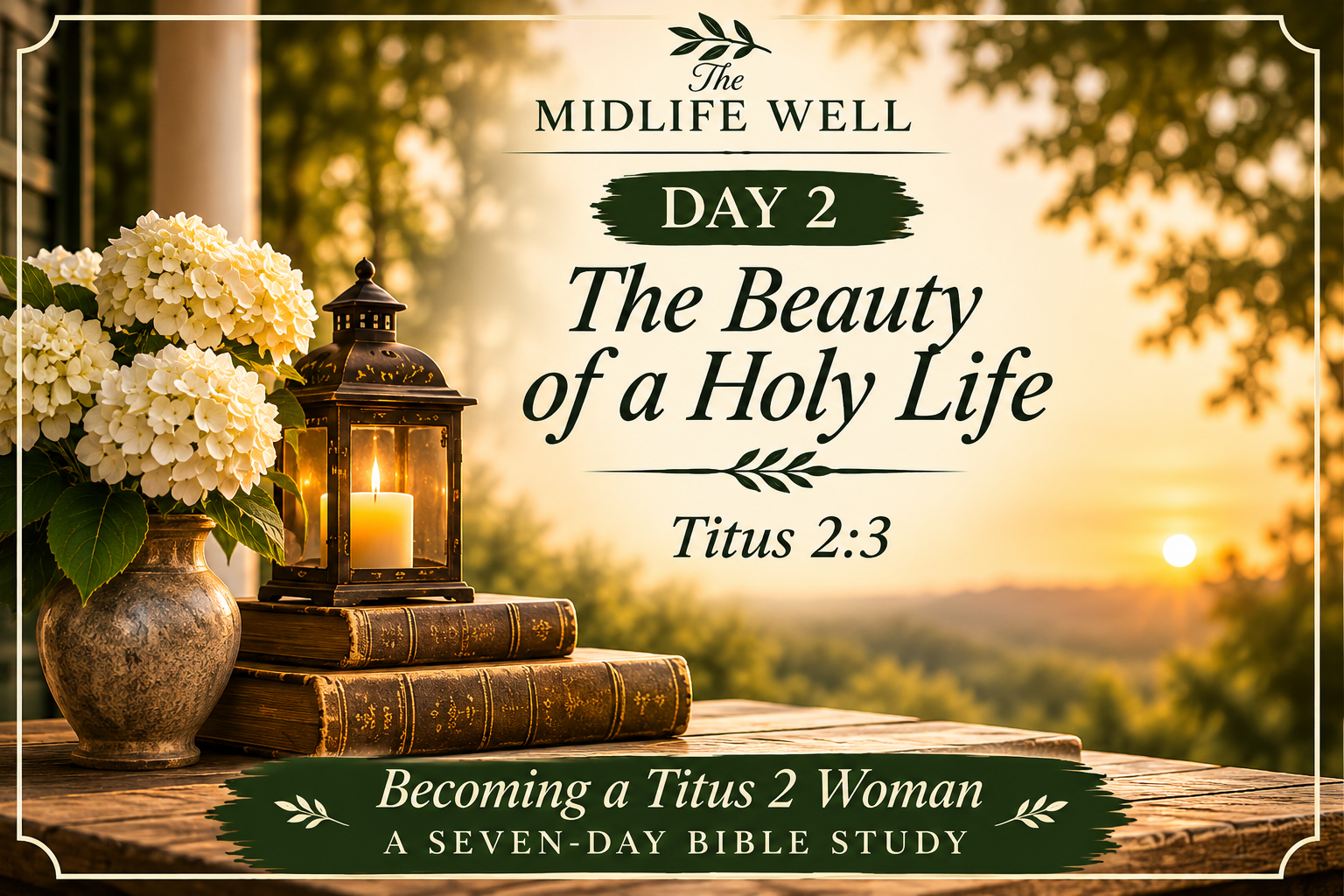
Growing Older in Grace, Wisdom, and Purpose
Scripture Reading: Titus 2:3 and 1 Peter 3:3–4 (KJV)
Good Morning, Ladies. Pull Up a Chair.
Yesterday, we talked about being called, not cast aside.
We discovered that growing older doesn't mean our purpose has expired. And we learned that spiritual maturity doesn't automatically come with another birthday.
Today, I want to take that conversation a little deeper.
Because there's something about Titus 2:3 that I don't want us to rush past.
Paul writes:
"The aged women likewise, that they be in behaviour as becometh holiness, not false accusers, not given to much wine, teachers of good things;" — Titus 2:3 (KJV)
Did you notice what comes before the instruction to teach?
Their behavior.
Before Paul tells older women to teach good things, he addresses the kind of lives they should be living.
And ladies, that deserves our attention.
What Does Holiness Actually Look Like?
When we hear the word holiness, what comes to mind?
Maybe we picture a woman who never misses church, always has her Bible close by, and knows exactly what to say when someone needs prayer.
Perhaps we think of the way someone dresses, the music they listen to, or the traditions they follow.
But holiness is deeper than outward appearances.
The word translated "holiness" in Titus 2:3 is connected with what is sacred and fitting for those who honor God.
Paul is calling older women to conduct themselves with reverence.
Not simply to look religious.
Not to impress other people.
But to live in a way that reflects their devotion to the Lord.
And here's where I want us to examine ourselves.
Is my faith something people only hear me talk about, or is it something they can see shaping my life?
That's a question for all of us, myself included.
A Holy Life Isn't a Perfect Life
Let's clear something up right here.
Being a godly woman doesn't mean you've never made a mistake.
It doesn't mean you've never lost your temper, spoken too quickly, or struggled with your attitude.
And it certainly doesn't mean you've reached an age where you no longer need correction.
If anything, growing in spiritual maturity should make us increasingly aware of our need for God's grace.
A holy life is not a performance of perfection.
It is a life being shaped by the Lord.
That includes repentance.
It includes humility.
It includes recognizing when our words have hurt someone and being willing to make things right.
It includes allowing Scripture to challenge beliefs and habits we've carried for years.
And sometimes, ladies, that's uncomfortable.
Because it's much easier to recognize what needs changing in somebody else's life than to acknowledge what God is showing us in our own.
The Beauty That Comes From Within
Now let's turn to 1 Peter 3.
Peter writes to Christian wives about their conduct, including the way they think about outward adornment.
In verses 3–4, we read:
"Whose adorning let it not be that outward adorning of plaiting the hair, and of wearing of gold, or of putting on of apparel;
But let it be the hidden man of the heart, in that which is not corruptible, even the ornament of a meek and quiet spirit, which is in the sight of God of great price." — 1 Peter 3:3–4 (KJV)
We need to understand this passage in its context.
Peter is addressing wives, and his emphasis is on the greater value of inward character rather than making outward appearance the source of one's beauty or worth.
He is not giving us a universal rule that women must never style their hair, wear jewelry, or enjoy beautiful clothing.
His point is that outward adornment cannot replace a heart shaped by God.
And I think that's especially meaningful in midlife.
Because we live in a world that constantly tells women to fight aging.
Buy the cream.
Hide the gray.
Erase the wrinkles.
Look younger.
Stay relevant.
But Scripture directs our attention to something that doesn't fade with age.
The beauty of a heart being transformed by God.
Now, there's nothing wrong with wanting to look nice or taking care of yourself.
But our spiritual worth is not measured by our appearance.
And the kind of beauty Peter describes cannot be purchased in a bottle.
It is cultivated through our relationship with the Lord.
What About a Meek and Quiet Spirit?
I want to spend a moment here because this phrase is sometimes misunderstood.
A meek and quiet spirit doesn't mean a woman has no voice.
It doesn't mean she must tolerate mistreatment or remain silent when something is wrong.
The qualities Peter commends concern inward gentleness and peacefulness of spirit, not an absence of courage or discernment.
Think about the women we encounter throughout Scripture.
Deborah exercised leadership and judgment.
Esther courageously approached the king.
Priscilla, alongside Aquila, helped explain the way of God more accurately to Apollos.
These women did not all have the same personalities or responsibilities.
Yet their lives remind us that faithfulness to God cannot be reduced to one particular temperament.
You can be strong and gentle.
You can speak truth and still be gracious.
You can establish boundaries and still love people.
Holiness is not about becoming a quieter version of yourself. It is about becoming a more Christlike version of yourself.
What Are We Teaching Without Saying a Word?
Let's return to Titus 2.
Paul describes older women as those who should be "teachers of good things."
But he places that instruction alongside the expectation of reverent behavior.
Why does that matter?
Because our example can either reinforce or contradict what we teach.
We can tell younger women to trust God while allowing fear to control every decision we make.
We can encourage forgiveness while holding tightly to bitterness.
We can teach kindness while speaking harshly about people who aren't in the room.
And we can talk about the importance of Scripture while rarely opening our own Bibles.
Now, none of us will live this out perfectly.
But the answer isn't to pretend.
The answer is to remain teachable.
Sometimes one of the most powerful examples we can give another woman is the humility to say:
"I was wrong."
"I need to apologize."
"I need to pray about my attitude."
"Let's open the Bible and see what it actually says."
There's beauty in that kind of honesty.
A Personal Thought From the Well
I've reached a season of life where I'm beginning to care less about appearing to have everything together.
Life has a way of reminding us how little control we actually have.
And I don't want to spend the years ahead of me trying to convince everyone that I'm a strong Christian woman.
I want to actually grow into one.
Not strong because I never struggle.
Not wise because I've lived a certain number of years.
But rooted in the Word of God.
I want my faith to show up in the ordinary moments.
When I'm tired.
When I'm frustrated.
When someone disappoints me.
When plans change.
When I have an opportunity to speak about someone who isn't present.
Because those are the moments when our character becomes visible.
And maybe that's where the beauty of a holy life is most clearly seen.
Not when everything is going well.
But when we allow the Lord to shape how we respond when it isn't.
Day 2: Let's Study Together
Read: Titus 2:3 and 1 Peter 3:3–4.
Take your time with these passages. Read the surrounding verses to understand whom Paul and Peter were addressing.
Then reflect on these questions:
What does Paul mean when he calls older women to behavior that reflects holiness?
Why is it significant that Paul addresses character alongside teaching?
How does Peter distinguish outward appearance from inward beauty?
Have I ever confused religious traditions or outward appearances with spiritual maturity?
What area of my character might God be asking me to surrender or change?
How can I demonstrate both strength and gentleness in my relationships?
Today's Journal Assignment
Complete these statements in your journal or printable worksheet.
One way my faith is visible in my everyday life is...
One attitude or habit I need to bring before God is...
One way I can demonstrate Christlike character this week is...
Today's Challenge
Before the day is over, choose one ordinary situation in which you can intentionally practice godly character.
Maybe it's responding patiently to someone who frustrates you.
Maybe it's choosing not to participate in gossip.
Maybe it's apologizing.
Or perhaps it's extending kindness to someone who cannot do anything for you in return.
Whatever it is, don't do it for recognition.
Do it as an expression of your love for God.
Let's Pray
Heavenly Father,
Thank You for reminding me that true beauty is not found in outward appearances but in a heart that belongs to You.
Lord, I know there are areas of my life that still need Your correction.
Help me recognize them without making excuses.
Teach me to walk in humility, gentleness, wisdom, and truth.
Guard my words and shape my attitudes.
Help me understand that holiness is not something I perform for others, but a life of devotion to You.
And Father, as I grow older, may my character increasingly reflect the work of Your grace.
Let my life point others toward Jesus.
In His precious name, Amen.
Before You Leave the Well...
I want to ask you something today.
When you think of a truly beautiful woman of faith, what qualities come to mind?
Not her appearance.
Not her accomplishments.
But the qualities of her heart.
Share your thoughts in the comments. Perhaps there's a woman whose example has helped shape your own walk with Christ.
Tomorrow, we're moving into Day 3: The Weight of Our Words.
And ladies, we're going to talk about something that can build up or tear down a relationship in a matter of seconds.
Until then, keep your Bible open and your heart teachable.
There's always room for another woman at the well.
The Midlife Well
Where midlife meets living water.