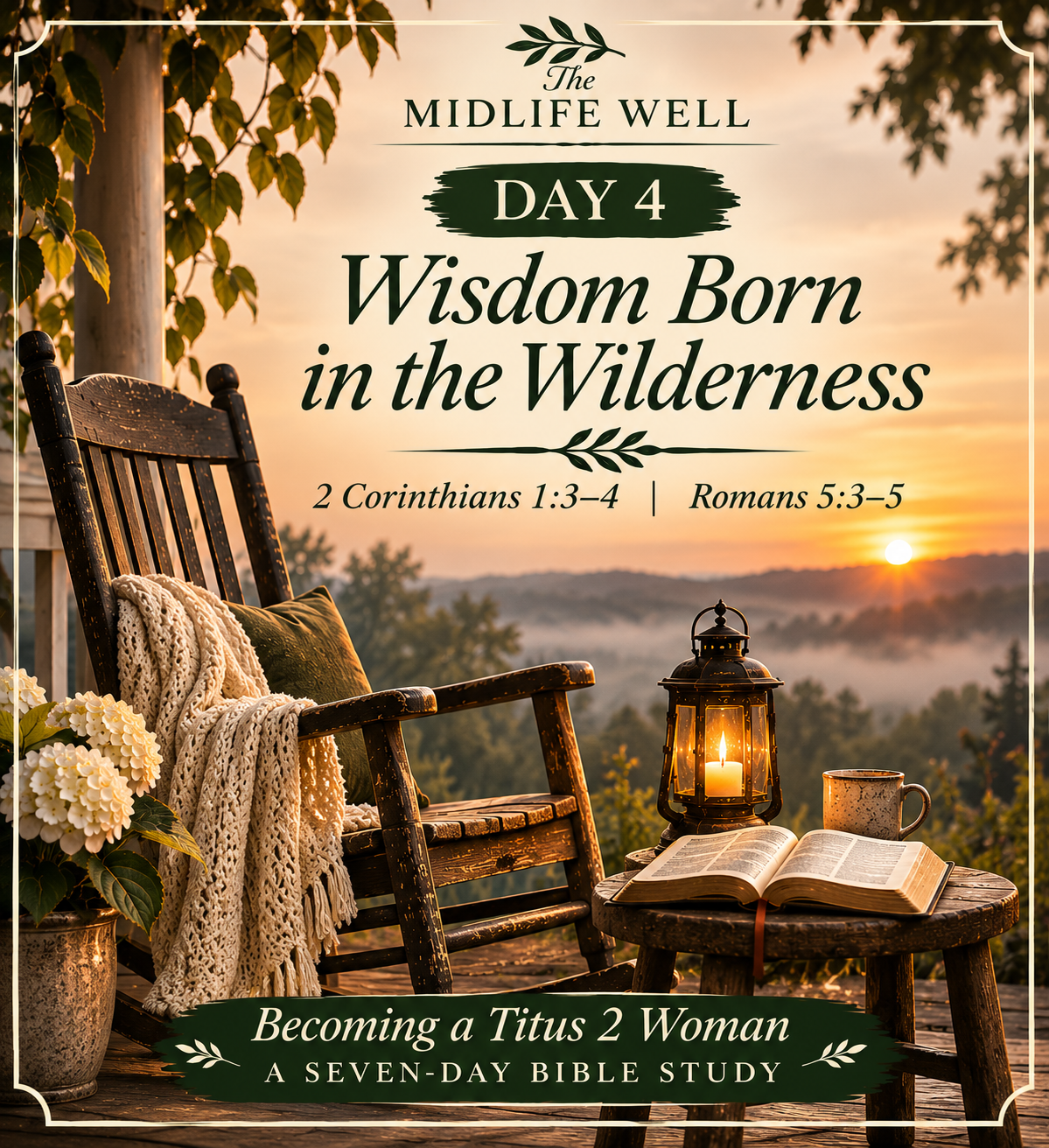
Becoming a Titus 2 Woman
Growing Older in Grace, Wisdom, and Purpose
Scripture Reading: 2 Corinthians 1:3–4 and Romans 5:3–5 (KJV)
Good Morning, Ladies. Pull Up a Chair.
Today, I want to talk about something that most of us know a little too well.
The wilderness.
Not the kind with trees, mountains, and beautiful scenery.
I'm talking about those seasons of life when everything feels uncertain.
The seasons when prayers seem unanswered.
When relationships fall apart.
When sickness enters your home.
When the bills keep coming, but the money doesn't.
When you're exhausted from being strong for everybody else.
And when you find yourself sitting alone, wondering how much more you can carry.
Ladies, if we've lived very long at all, chances are we've walked through a wilderness or two.
Some of those seasons lasted a few weeks.
Others lasted years.
And some of us may be walking through one right now.
But today, I want us to look at something important.
What does Scripture actually teach us about suffering, comfort, and the wisdom we gain through life's difficult seasons?
Because I don't want us to simply say, "Everything happens for a reason," and move on.
I want us to open our Bibles.
I want us to understand what God says.
And I want us to discover how the comfort we've received from Him can become a source of encouragement to another woman.
The God of All Comfort
Let's begin with 2 Corinthians 1:3–4.
The apostle Paul writes:
"Blessed be God, even the Father of our Lord Jesus Christ, the Father of mercies, and the God of all comfort;
Who comforteth us in all our tribulation, that we may be able to comfort them which are in any trouble, by the comfort wherewith we ourselves are comforted of God." — 2 Corinthians 1:3–4 (KJV)
Now, ladies, I want you to notice something.
Paul doesn't say God will keep us from every difficult experience.
He says God comforts us in our tribulation.
That's an important distinction.
And we need to understand the context.
Paul wrote 2 Corinthians to believers in Corinth while addressing difficulties, opposition, and suffering connected with his ministry.
In the verses that follow, he describes affliction so severe that he and his companions despaired even of life.
This wasn't a man writing about hardship from a comfortable distance.
Paul knew what it meant to suffer.
Yet he begins by praising God as the Father of mercies and the God of all comfort.
And then he tells us something remarkable.
The comfort we receive from God equips us to comfort others.
Think about that.
God's comfort isn't something we have to keep to ourselves.
It can become part of how we minister to another person.
Comfort Doesn't Mean We Have All the Answers
Have you ever sat beside someone who was hurting and felt completely inadequate?
Maybe a friend lost her husband.
Maybe someone received a frightening diagnosis.
Maybe a younger woman confided that her marriage was falling apart.
And you wanted so badly to say something that would make everything better.
But you couldn't find the words.
Ladies, here's something I've learned.
Sometimes the most meaningful ministry isn't having the right answer. It's being willing to sit beside someone who is hurting.
We don't have to explain every tragedy.
We don't have to tell someone why God allowed something to happen.
And we certainly don't have to turn another person's pain into a lesson before they've even had time to grieve.
Sometimes comfort looks like a phone call.
A meal delivered to someone's home.
A prayer whispered beside a hospital bed.
Or simply saying, "I don't know what to say, but I'm here."
That doesn't mean our presence replaces God's comfort.
It means we can become instruments through which His compassion is expressed.
And that brings us right back to Titus 2.
What Does the Wilderness Have to Do With a Titus 2 Woman?
Let's remember what Paul tells older women in Titus 2:3.
He calls them to live reverently and to be "teachers of good things."
Yesterday, we examined the weight of our words.
Today, we're looking at another dimension of that responsibility.
What do we do with the experiences we've gained through the years?
You see, older women have often lived through circumstances younger women haven't encountered yet.
We've experienced disappointment.
We've watched plans change.
We've learned that people can fail us.
We've discovered that some prayers are answered differently than we expected.
And many of us have learned what it means to depend on God when our own strength is gone.
But here's where we need to be careful.
Experience alone doesn't automatically make us wise.
We can go through suffering and come out bitter.
We can allow disappointment to make us suspicious of everyone.
We can become so convinced that our own experiences are universal that we stop listening to anyone whose life looks different from ours.
That's why biblical wisdom requires more than simply having a difficult testimony.
It requires humility.
Discernment.
A willingness to keep learning.
And a commitment to measure what we teach against Scripture.
Our experiences may give us stories to share, but God's Word must remain the foundation of what we teach.
When Suffering Produces Endurance
Now let's turn to Romans 5:3–5.
Paul writes:
"And not only so, but we glory in tribulations also: knowing that tribulation worketh patience;
And patience, experience; and experience, hope:
And hope maketh not ashamed; because the love of God is shed abroad in our hearts by the Holy Ghost which is given unto us." — Romans 5:3–5 (KJV)
Let's look at this carefully.
Paul has just explained that believers have peace with God through Jesus Christ and access by faith into grace.
He then speaks about rejoicing in the hope of God's glory.
And from there, he makes an unexpected statement.
He says believers can also rejoice in tribulations.
Now, does that mean we're supposed to enjoy suffering?
No.
Does it mean we should pretend painful things don't hurt?
Absolutely not.
Paul isn't teaching us to celebrate abuse, ignore danger, or deny grief.
He's explaining that suffering, within the Christian life, can produce endurance.
That endurance contributes to tested character.
And tested character strengthens hope.
But notice where that hope ultimately rests.
Not in our ability to survive anything.
Not in our toughness.
Not in the belief that life will always get easier.
Our hope rests in God and His love poured into our hearts through the Holy Spirit.
Ladies, that's important.
Because sometimes we talk about being strong women as though strength means never breaking down.
Never crying.
Never asking for help.
Never admitting we're overwhelmed.
But biblical endurance isn't the same as pretending nothing hurts.
Sometimes endurance looks like getting out of bed and praying when you don't know what else to do.
Sometimes it means accepting help.
Sometimes it means continuing to trust God's character even when you don't understand your circumstances.
And sometimes it means recognizing that you cannot carry everything alone.
Not Every Wilderness Was Sent to Teach You a Lesson
I want to stop here because I think this is something we need to understand.
When someone is suffering, Christians sometimes rush to explain it.
"God is trying to teach you something."
"Everything happens for a reason."
"God won't give you more than you can handle."
But we need to be careful about making statements Scripture doesn't actually support in that form.
Romans 5 teaches that God can produce endurance, character, and hope through tribulation.
It doesn't give us permission to claim we know why every painful event occurred.
And 2 Corinthians 1 teaches us about God's comfort.
It doesn't tell us to minimize someone else's suffering.
Sometimes terrible things happen because we live in a fallen world.
Sometimes people make harmful choices.
Sometimes we face illness, loss, and circumstances beyond our control.
We don't always know why.
And we don't have to invent an explanation.
We can trust God without pretending we understand everything He has allowed.
That may be one of the most important lessons we can pass down to younger women.
Faith doesn't require us to have an answer for every question.
It calls us to place our trust in the One who remains faithful.
The Difference Between Wisdom and Bitterness
Ladies, let's have an honest conversation.
Have you ever met someone who has been through so much that they've become hardened by life?
Maybe they no longer trust anyone.
Maybe every conversation returns to what someone did to them.
Maybe their pain has become the lens through which they see everything.
Now, I'm not saying that people who struggle after trauma or loss lack faith.
Healing can take time, and some wounds require professional support as well as spiritual care.
But I do think we should examine what we're allowing our experiences to produce in us.
Are we becoming more compassionate?
Or more critical?
More understanding?
Or more judgmental?
More willing to listen?
Or more determined to prove that we know best?
Our suffering doesn't automatically produce wisdom.
We must remain open to God's work in our hearts.
And sometimes that means acknowledging that we've carried bitterness longer than we should.
Sometimes it means asking for help.
Sometimes it means forgiving someone while still maintaining necessary boundaries.
And sometimes it means admitting that we haven't fully healed from something we thought we'd moved beyond.
There's no shame in recognizing that we still have growing to do.
What Will You Do With What You've Survived?
I want you to think about the younger women in your life.
Maybe there's a young mother who is exhausted.
A woman navigating a difficult marriage.
Someone facing financial hardship.
A daughter grieving a loss.
Or a friend who feels as though she's failing at everything.
What could you offer her?
Not a lecture.
Not a comparison.
Not a story about how you had it harder.
But perhaps a little understanding.
Maybe you can tell her that she's allowed to ask for help.
Maybe you can share how prayer sustained you during a difficult season.
Maybe you can remind her that she doesn't have to understand everything today.
Or maybe you can simply listen without trying to fix her.
One of the greatest gifts an older woman can give a younger woman is the wisdom to know when her experience can help—and when it's time to simply listen.
That's the kind of Titus 2 woman I want to become.
A Personal Thought From the Well
Ladies, I've had seasons in my life that I never would have chosen.
Seasons that stretched me emotionally, physically, and spiritually.
There have been moments when I felt strong in my faith.
And there have been moments when all I could manage was a simple prayer.
"Lord, help me."
I've learned that sometimes the hardest part of a wilderness season isn't the difficulty itself.
It's the uncertainty.
Not knowing how long it will last.
Not knowing what tomorrow will bring.
Not knowing whether the situation will ever change.
And I've also learned that I don't have to pretend those seasons are easy.
God doesn't need me to put on a brave face for Him.
He already knows my heart.
But as I look at the years ahead, I want to be careful about what I carry forward.
I don't want to carry every disappointment as bitterness.
I don't want to allow every hurt to become a wall.
And I don't want to use my difficult experiences as an excuse to stop growing.
I want to carry forward the lessons that are rooted in truth.
The compassion I've learned.
The humility I've gained.
And the understanding that sometimes people don't need another opinion.
They just need someone who cares.
Maybe that's part of what it means to become a Titus 2 woman.
Not a woman who has never walked through the wilderness, but a woman who has learned to offer comfort because she knows what it means to need it.
Day 4: Let's Study Together
Read: 2 Corinthians 1:3–11 and Romans 5:1–5.
Take time to read the surrounding verses, not just the key passages.
Then reflect on these questions:
How does Paul describe God in 2 Corinthians 1:3?
According to verse 4, what is one purpose of the comfort believers receive from God?
What progression does Paul describe in Romans 5:3–5?
What is the foundation of Christian hope in Romans 5?
Have difficult experiences made me more compassionate toward others, or are there areas where bitterness has taken root?
How can I share wisdom from my experiences without assuming everyone else's circumstances are the same as mine?
Today's Journal Assignment
Complete these statements:
One difficult season that has shaped my faith is...
One way I experienced God's comfort during that season was...
One lesson I can share with another woman, while remaining faithful to Scripture, is...
Today's Challenge: Become a Source of Comfort
Think of one woman who may be walking through a difficult season.
Reach out to her today.
You don't need a perfect speech.
You don't need to solve her problems.
Simply ask how she's doing.
Listen.
Offer encouragement.
And if appropriate, ask whether you can pray with her.
Sometimes the smallest acts of compassion make the greatest difference.
Let's Pray
Heavenly Father,
Thank You for being the Father of mercies and the God of all comfort.
Lord, You know every difficult season I've walked through.
You know the prayers I've whispered through tears, the questions I've carried, and the moments when I didn't know what to do next.
Thank You that I don't have to pretend to be strong when I come before You.
Help me trust You even when I don't understand my circumstances.
Guard my heart against bitterness, pride, and resentment.
Teach me to grow in endurance, character, and hope.
And Father, when You place another woman in my path who is hurting, help me remember the comfort I've received.
Give me wisdom to know when to speak and when to listen.
May my experiences never become more important than Your Word.
And may my life point others toward the compassion and faithfulness of Jesus Christ.
In His precious name, Amen.
Before You Leave the Well...
Ladies, I want to ask you something today.
What is one thing a difficult season of life has taught you about showing compassion to others?
You don't have to share the details of your wilderness.
Sometimes the lesson is enough.
And if you're still walking through a difficult season, please know you don't have to have it all figured out before you can join this conversation.
Tomorrow, we're moving into Day 5: The Ministry of Mentoring.
We're going to explore what it actually means for older women to teach younger women, and why mentoring is about much more than giving advice.
Until then, keep your Bible open, your heart teachable, and remember:
The comfort God has given you may become the very encouragement another woman needs.
There's always room for another woman at the well.
The Midlife Well
Where midlife meets living water.